


The crack of the bat, the roar of a packed stadium, and the heart-stopping drama of a final-over finish—nothing encapsulates the modern era of cricket quite like the ICC Men's T20 World Cup.
In the early 2000s, cricket was at a crossroads. While Test matches retained their purist charm and One Day Internationals (ODIs) drove the sport's economy, there was a growing need for a shorter, punchier format that could appeal to a younger, time-poor audience. Enter Twenty20 cricket. Recognizing the explosive potential of this new format, the International Cricket Council (ICC) introduced a global tournament to crown the ultimate short-format champion.
When the inaugural T20 World Cup kicked off in 2007, few could have predicted the seismic shift it would cause. It wasn't just a tournament; it was a cultural reset for the sport. Today, the T20 World Cup stands as one of the biggest, most lucrative, and most heavily anticipated sporting events on the planet, evolving from a brief 12-team experiment into a massive 20-team global spectacle.
For cricket fans, analysts, and researchers, understanding the history of this tournament is essential to understanding modern cricket itself. Let’s dive into the complete history, origins, winners, and iconic records of the ICC Men’s T20 World Cup.
Origins of T20 Cricket
Before it became a global phenomenon, T20 cricket had humble beginnings as a domestic marketing experiment.
In 2003, the England and Wales Cricket Board (ECB) was facing a crisis. Domestic attendance was dwindling, and younger demographics were turning their attention to other fast-paced sports like football and rugby. Stuart Robertson, the ECB’s marketing manager at the time, proposed a radical idea: a 20-overs-per-side match that could be completed in just three hours.
The format was introduced to the English county circuit as the Twenty20 Cup. It was an instant blockbuster. The matches featured loud music, cheerleaders, and evening start times that allowed fans to attend after work or school. Players were forced to innovate, prioritizing power-hitting, athletic fielding, and clever bowling variations over traditional, textbook cricket.
The success was undeniable, and within just two years, the format made its international debut. The first-ever Men's T20 International (T20I) was played between Australia and New Zealand in 2005. The players wore retro kits and initially treated it as a bit of fun—but the massive crowd response proved that T20 cricket was here to stay.
When and How the T20 World Cup Started
Recognizing the format's explosive growth, the ICC announced the first-ever global T20 tournament. The 2007 ICC World Twenty20 was hosted by South Africa.
Interestingly, several major cricketing boards, including the Board of Control for Cricket in India (BCCI), were initially skeptical of the format, viewing it as a distraction from ODIs and Tests. India even sent a young, relatively inexperienced squad led by a newly appointed captain, MS Dhoni, resting major veterans like Sachin Tendulkar, Rahul Dravid, and Sourav Ganguly.
However, the 2007 tournament delivered unmatched drama. From Chris Gayle scoring the first-ever T20I century in the opening match to India’s thrilling "bowl-out" victory against Pakistan in the group stages, the world was hooked.
The climax of the tournament changed the landscape of world cricket forever. India faced Pakistan in a historic final in Johannesburg. In a match that went down to the very last over, Pakistan's Misbah-ul-Haq attempted a daring scoop shot off Joginder Sharma, only to be caught by Sreesanth at short fine-leg. India won the inaugural World Cup by just 5 runs. The victory sparked mass euphoria in India, shifting the global cricketing epicenter and proving that T20 was the future of the sport.
Why the T20 World Cup Was Created
The ICC had several strategic reasons for backing the T20 format with a World Cup:
- Attracting Younger Audiences: Three hours of high-octane action aligned perfectly with shrinking attention spans and modern entertainment consumption habits.
- Prime-Time Viewership: T20 matches could be broadcast entirely during prime-time television slots, drastically increasing ad revenue and viewership numbers.
- Fast-Paced Entertainment: The format inherently demanded risk-taking, big hitting, and constant action, making it highly marketable to non-traditional cricket fans.
- Global Expansion: Because the matches are shorter, the skill gap between "Associate" nations and "Full Member" nations narrows. T20 provided the perfect vehicle to introduce cricket to new markets like the USA, Canada, and mainland Europe.
Complete T20 World Cup Winners List
From its inception in 2007 to the most recent mega-event in 2026, the T20 World Cup has seen spectacular champions and heart-breaking runner-up finishes. Here is the complete historical list:
| Year | Winner | Runner-Up | Host Country |
|---|---|---|---|
| 2007 | India | Pakistan | South Africa |
| 2009 | Pakistan | Sri Lanka | England |
| 2010 | England | Australia | West Indies |
| 2012 | West Indies | Sri Lanka | Sri Lanka |
| 2014 | Sri Lanka | India | Bangladesh |
| 2016 | West Indies | England | India |
| 2021 | Australia | New Zealand | UAE & Oman |
| 2022 | England | Pakistan | Australia |
| 2024 | India | South Africa | USA & West Indies |
| 2026 | India | New Zealand | India & Sri Lanka |
Most Successful Teams
The landscape of T20 cricket is incredibly volatile, making consistent dominance extremely rare. However, a few teams have managed to etch their names in gold:
- India (3 Titles): The undisputed kings of the modern era. After winning the inaugural 2007 edition, India endured a long drought before reclaiming the trophy in 2024. They then achieved the impossible in 2026—becoming the first team in history to win back-to-back T20 World Cups, the first to win it on home soil as hosts, and the first to reach three overall titles under the brilliant leadership of Suryakumar Yadav and the heroics of Sanju Samson and Jasprit Bumrah.
- West Indies (2 Titles): The pioneers of T20 power-hitting. With a squad built purely on muscle, flair, and boundary-hitting prowess, the Windies dominated the 2012 and 2016 editions.
- England (2 Titles): The innovators of modern white-ball aggression. Their 2010 victory was their first-ever ICC global trophy, and their 2022 win in Australia cemented their status as a white-ball dynasty.
- Pakistan: One of the most consistent teams in T20 World Cup history, winning in 2009 and finishing as runners-up in 2007 and 2022.
Greatest Matches in T20 World Cup History
The T20 World Cup is defined by moments of pure magic. Here are some of the most legendary encounters:
- 2007 Final (India vs. Pakistan): The match that started it all. Joginder Sharma's final over, Misbah's scoop, and Sreesanth's catch. A heart-stopping 5-run win for India.
- 2016 Final (West Indies vs. England): Needing 19 runs off the final over to win, an unknown Carlos Brathwaite smashed Ben Stokes for four consecutive sixes, prompting Ian Bishop's iconic commentary: "Carlos Brathwaite! Remember the name!"
- 2022 Super 12 (India vs. Pakistan): Chasing 160 at a packed MCG, India looked down and out before Virat Kohli played the innings of a lifetime (82* off 53), including an unbelievable straight six off Haris Rauf that defied the laws of physics.
- 2024 Final (India vs. South Africa): A choking South African side needed just 30 runs off 30 balls, but brilliant death bowling by Jasprit Bumrah and a boundary-rope wonder-catch by Suryakumar Yadav handed India their second title.
- 2026 Final (India vs. New Zealand): A masterclass in batting destruction. India posted an earth-shattering 255/5 in Ahmedabad, completely dismantling the Kiwi bowling attack and securing a 96-run victory to defend their crown.
Major T20 World Cup Records
The T20 format is a statistical paradise. Here are the defining records of the tournament:
- Most Runs in Tournament History: Virat Kohli (India) – The undisputed run machine of the T20 World Cup, known for his incredible average and ability to anchor high-pressure chases.
- Most Wickets in Tournament History: Shakib Al Hasan (Bangladesh) – A testament to his extreme longevity and effectiveness as a left-arm spinner across over eight editions of the tournament.
- Highest Team Total: Sri Lanka’s 260/6 against Kenya in 2007 remains the highest overall, but India’s 255/5 against New Zealand in 2026 stands as the highest-ever total in a T20 World Cup Final.
- Fastest Century: Chris Gayle (West Indies) – Reached his 100 in just 47 balls against England in 2016.
Evolution of Tournament Format
The tournament structure has undergone significant changes to accommodate the sport's global growth:
- The Early Years (12 Teams): The first few tournaments featured 12 teams divided into four groups, quickly advancing to the "Super 8" stages.
- The Super 10 & Super 12 Era: As Associate nations improved, the ICC introduced preliminary qualifying rounds. Lower-ranked teams fought for a spot against the top 8 ranked nations in the "Super 10" (2014, 2016) and later the "Super 12" (2021, 2022) stages.
- The 20-Team Mega Event (2024 & 2026): To truly globalize the sport, the ICC expanded the tournament to 20 teams. Teams are divided into four groups of five, with the top two from each group advancing to a "Super 8" round-robin, followed by the semi-finals and final.
Impact of the T20 World Cup on Global Cricket
It is impossible to overstate the impact the T20 World Cup has had on the sport of cricket:
- The Rise of Franchise Leagues: India’s victory in 2007 directly catalyzed the creation of the Indian Premier League (IPL) in 2008. The IPL’s massive commercial success birthed similar leagues globally, including the BBL (Australia), PSL (Pakistan), and CPL (West Indies).
- Evolution of Skill: The demands of T20 have revolutionized batting. Shots that were once unthinkable—ramp shots, switch hits, and reverse sweeps—are now standard. Bowlers have had to counter with wide yorkers, knuckleballs, and disguised slower bouncers.
- Financial Independence for Players: T20 cricket turned cricketers into global freelancers. Players no longer need to rely solely on national central contracts; they can build lucrative careers purely as T20 specialists.
- Global Fan Engagement: Shorter match times have allowed cricket to penetrate non-traditional markets, drawing in fans who previously found the sport too complex or time-consuming.
Future of the T20 World Cup
The future of the T20 World Cup looks incredibly bright. Moving forward, the ICC aims to continue its global expansion. With cricket officially returning to the Olympic Games for Los Angeles 2028 (played in the T20 format), the prestige of T20I cricket will only skyrocket.
Expect future tournaments to feature deeper integration of AI analytics, more host nations outside the traditional "Big Three" (India, Australia, England), and potentially even further expansion beyond 20 teams as the sport continues its global crusade.
Frequently Asked Questions (SEO Section)
When was the first T20 World Cup played? The inaugural ICC Men's T20 World Cup was held in September 2007 in South Africa, with India emerging as the champions.
Which team has won the most T20 World Cups? India is the most successful team in the tournament's history, having won the title three times (2007, 2024, and 2026).
How often is the T20 World Cup held? The tournament is generally held every two years, though scheduling adjustments have occasionally occurred due to global events or other ICC tournaments.
How many teams participate in the T20 World Cup? Since the 2024 edition, the tournament format has expanded to include 20 participating nations, making it the most inclusive World Cup in cricket history.
Who has the most runs in T20 World Cup history? India's Virat Kohli holds the record for the most runs scored in T20 World Cup history, consistently dominating bowling attacks across multiple editions.
Who won the latest T20 World Cup? India won the 2026 T20 World Cup, defeating New Zealand by 96 runs in the final held in Ahmedabad, India.
Audience Engagement & CricPredictor Community Section
Over to You: Have Your Say! The T20 World Cup has given us over a decade and a half of pure adrenaline. According to you, which T20 World Cup final was the most thrilling in cricket history? Was it the historic 2007 bowl-out era, the Brathwaite fireworks of 2016, or India's majestic title defense in 2026? Drop your thoughts in the comments below!
Predict the Future with CricPredictor As the T20 format continues to evolve, staying ahead of the game is crucial. For data-driven match predictions, deep-dive team analysis, and real-time tournament insights, explore more guides on CricPredictor.com. Our algorithms break down the game so you don't have to.
Explore More on CricPredictor:
- Live Match Previews & Odds
- Detailed Team Profiles & Player Analytics
- Comprehensive Cricket Records & Statistics
- T20 Franchise League Predictions (IPL, PSL, BBL)
Join the Winning Team
Don't miss a single yorker, six, or stump-mic moment! Bookmark CricPredictor.com to stay updated with the latest cricket predictions, stats, and tournament insights. Join our growing community of cricket analysts and superfans today!
Who Will Qualify for the Final in T20 World Cup 2026?
T20 World Cup 2026 Betting Strategies
ICC Breaking News 2026: T20 World Cup Super Eight Drama & WTC Race Update
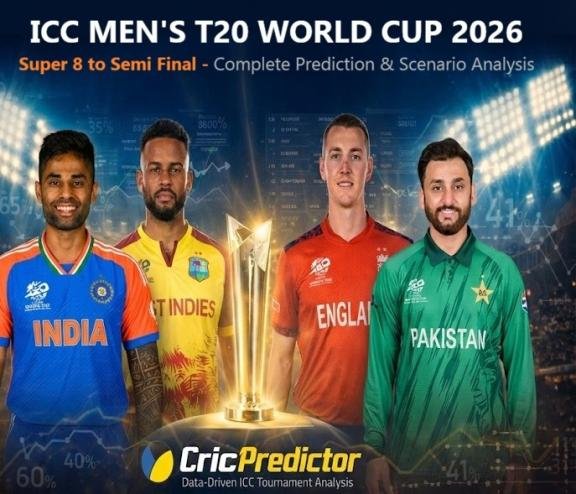
ICC Men’s T20 World Cup 2026: Super 8 to Semi Final – Complete Prediction & Scenario Analysis
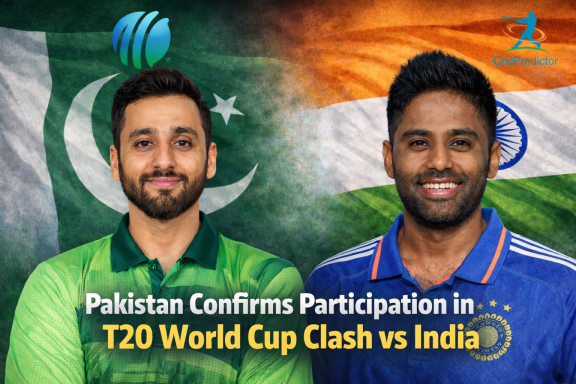
Pakistan Confirms Participation in T20 World Cup Clash vs India
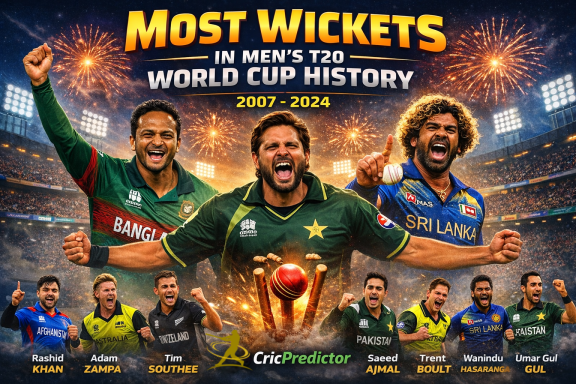
Most Wickets in Men’s T20 World Cup History
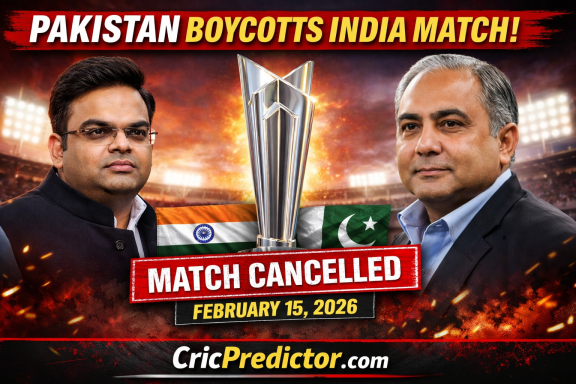
Pakistan Boycotts India Match in T20 World Cup 2026
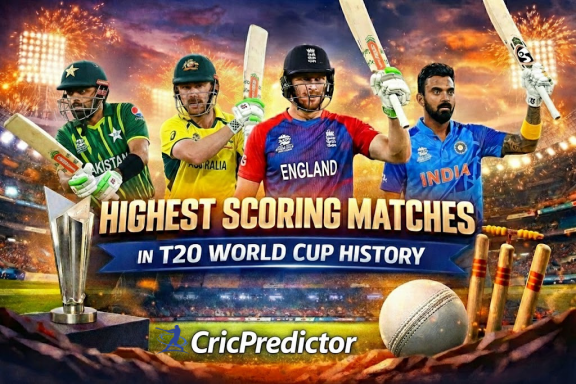
Highest Scoring Matches in Men’s T20 World Cup History


